“And now for something completely different.” Or maybe not – since Saint Francis didn’t lend money. He didn’t possess any.
Usury: lending money at interest
I was visiting family this week, so I took this an as easy topic: I’d just find the Scriptural and Patristic references to Usury and copy them here. Wrong! I found so many quotes calling Usury a grievous sin that it’s been difficult culling them and narrowing them down.
What got my mind moving about this was the article I wrote last summer about C.S. Lewis, on a different topic. In the process I happened across what he said in Mere Christianity about Usury – which is copied below. The subject has hung in my mind ever since.
Is this economic issue an appropriate “religious” topic? According to the Scriptures and the Fathers, Yes. They saw it as a moral issue.
I trust that we all, as Orthodox Christians, are committed to Scriptural, Patristic Christianity, and I keep thinking what is written there about Usury must have some application to us today – but what is it? I’m perplexed. So in what follows, am I trying to make a socio/economic/political point? I have no idea. Like Lewis, I’m no economist, nor am I a sociologist or a politician. * I’m curious how Orthodox economists and sociologists and politicians might deal with this subject.
- I, the old man, do have one observation: In my grandparents’ generation (up till the mid-Twentieth Century), at least where I grew up in rural Ohio, people almost never borrowed from lenders at interest. Almost always they saved up till they could afford to buy what they wanted. If in emergency they had to borrow, it was usually from a family member who did not charge interest. (Shakespeare: “Neither a borrower nor a lender be.”) Times have changed. Why?
C.S. Lewis on Usury
 C.S. Lewis Foundation
“There is one bit of advice given to us by the ancient heathen Greeks, and by the Jews in the Old Testament, and by the great Christian teachers of the Middle Ages, which the modern economic system has completely disobeyed. All these people told us not to lend money at interest: and lending money at interest — what we call investment — is the basis of our whole system. Now it may not absolutely follow that we are wrong. Some people say that when Moses and Aristotle and the Christians agreed in forbidding interest (or “usury” as they called it), they could not foresee the joint stock company, and were only thinking of the private moneylender, and that, therefore, we need not bother about what they said.
“That is a question I cannot decide on. I am not an economist and I simply do not know whether the investment system is responsible for the state we are in or not. This is where we want the Christian economist. But I should not have been honest if I had not told you that three great civilizations had agreed (or so it seems at first sight) in condemning the very thing on which we have based our whole life.”
Mere Christianity, Book III, Part 3 (Social Morality)
Some Scriptural Teachings about Usury
Old Testament
I include Old Testament quotes not because Old Testament Law is required of Christians (see Acts 15), but to show the attitude at the time about Usury. Note that it usually decries the evil of loaning money at interest to “your brother”. Is this why Jews became the moneylenders in Medieval times – because they could loan to Christians who were not their “brothers”?
If you lend money to any of my people with you who is poor, you shall not be like a moneylender to him, and you shall not exact interest from him. Exodus 22:25
Take no interest from him or profit, but fear your God, that your brother may live beside you. You shall not lend him your money at interest, nor give him your food for profit. Leviticus 25:36-37
 Prophet Moses (All icons by permission of Saint Isaac’s Skete at skete.com)
You shall not charge interest on loans to your brother, interest on money, interest on food, interest on anything that is lent for interest. You may charge a foreigner interest, but you may not charge your brother interest, that the Lord your God may bless you in all that you undertake in the land that you are entering to take possession of it. Deuteronomy 23:19-20
Whoever does not put out his money at interest and does not take a bribe against the innocent, He who does these things shall never be moved. Psalm 15:5
Whoever multiplies his wealth by interest and profit gathers it for another who will be generous to the poor. Proverbs 28:8
Whoever lends at interest, and takes profit; shall he then live? He shall not live. He has done all these abominations; he shall surely die; his blood shall be upon himself. Ezekiel 18:13
This parable might seem to justify Usury: To the unworthy servant who did not increase the gifts given him, the Lord says: “Then you ought to have invested my money with the bankers, and at my coming I should have received what was my own with interest.” Matthew 25:27
James Tissot, c 1890, at Brooklyn Museum
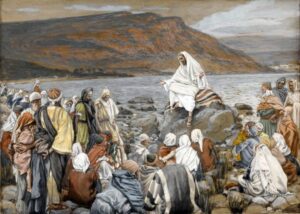 However, here is Christ’s specific teaching: “And if you lend to those from whom you expect repayment, what credit is that to you? Even sinners lend to sinners, expecting to be repaid in full. But love your enemies, do good to them, and lend to them without expecting to get anything back. Then your reward will be great, and you will be children of the Most High, because he is kind to the ungrateful and wicked.”
The Church Fathers on Usury
Based on Christ’s teaching, the Fathers apparently completely forbade lending money at interest.
… let it suffice to remark that the law prohibits a brother from taking Usury. Saint Clement of Alexandria
If [a Christian] shall have lent any money, he will not receive interest, that the benefit may be unimpaired which succors necessity, and that he may entirely abstain from the property of another. For in this kind of duty he ought to be content with that which is his own; since it is his duty in other respects not to be sparing of his property, in order that he may do good; but to receive more than he has given is unjust. And he who does this lies in wait in some manner, that he may gain booty from the necessity of another. But the just man will omit no opportunity of doing anything mercifully: nor will he pollute himself with gain of this kind; but he will so act that without any loss to himself, that which he lends may be reckoned among his good works. Lactantius (advisor to Saint Constantine the Great)
 Money lending has no value and is rapacious. It is unfamiliar with such trades as agriculture and commerce… Money lending wants everything to be wild and begets whatever has been untilled… Usury’s home is a threshing-floor upon which the fortunes of the oppressed are winnowed and where it considers everything as its own. It prays for afflictions and misfortunes in order to destroy such persons. Money lending despises people contented with their possessions and treats them as enemies because they do not provide money. It watches courts of law to find distress in persons who demand payment and follows tax collectors who are a nest of vultures in battle array prepared for war. Money lending carries a purse and dangles bait as a wild beast to those in distress in order to ensnare them in their need. Daily it counts gain and cannot be satisfied. It is vexed by gold hidden in a person’s home because it remains idle and unprofitable. Usury imitates farmers who immediately plant crops; it takes and gives money without gain while transferring it from one hand to another. Saint Gregory of Nyssa
Listen, you rich men, to the kind of advice I am giving to the poor because of your inhumanity: Far better endure under their dire straits than undergo the troubles that are bred of Usury! But if you were obedient to the Lord, what need of these words? What is the advice of the Master? Lend to those from whom you do not hope to receive. And what kind of loan is this, it is asked, from all which all idea of the expectation of repayment is withdrawn? Consider the force of the expression, and you will be amazed at the loving kindness of the legislator. When you mean to supply the need of a poor man for the Lord’s sake, the transaction is at once a gift and a loan. Because  there is no expectation of reimbursement, it is a gift. Yet because of the munificence of the Master, Who repays on the recipient’s behalf, it is a loan. ‘He that hath pity on the poor lendeth unto the Lord.’ Do you not wish the Master of the universe to be responsible for your repayment? If any wealthy man in the town promises you repayment on behalf of others, do you admit his suretyship? But you do not accept God, Who more than repays on behalf of the poor. Give the money lying useless, without weighting it with increase, and both shall be benefited. To you will accrue the security of its safe keeping. The recipients will have the advantage of its use. And if it is increase which you seek, be satisfied with that which is given by the Lord. He will pay the interest for the poor. Await the loving-kindness of Him Who is in truth most kind. “What you are taking involves the last extremity of inhumanity. You are making your profit out of misfortune; you are levying a tax upon tears. You are strangling the naked. You are dealing blows on the starving. There is no pity anywhere, no sense of your kinship to the hungry, and you call the profit you get from these sources kindly and humane! … Men do not gather grapes of thorns, nor figs of thistles, nor humanity of usury. A corrupt tree bringeth forth evil fruit. There are such people as twelve-per-cent-men and ten-per-cent-men: I shudder to mention their names. They are exactors by the month, like the demons who produce epilepsy, attacking the poor as the changes of the moon come round. Here there is an evil grant to either, to giver and to recipient. To the latter, it brings ruin on his property; to the former, on his soul. The husbandman, when he has the ear in store, does not search also for the seed beneath the root; you both possess the fruit and cannot keep your hands from the principal. You plant where there is no ground. You reap where there has been no sowing. For whom you are gathering you cannot tell. The man from whom usury wrings tears is manifest enough; but it is doubtful who is destined to enjoy the results of the superfluity. You have laid up in store for yourself the trouble that results from your iniquity, but it is uncertain whether you will not leave the use of your wealth to others. Therefore, ‘from him that would borrow of you, turn not away;’ and do not give your money upon usury. Learn from both Old and New Testament what is profitable for you, and so depart hence with good hope to your Lord; in Him you will receive the interest of your good deeds – in Jesus Christ our Lord to Whom be glory and might for ever and ever, Amen. Saint Basil the Great (Homily on Psalm 14 “Against Usury”)
 Nothing, nothing is baser than the usury of this world, nothing more cruel. Why, other persons’ calamities are such a man’s traffic; he makes himself gain of the distress of another, and demands wages for kindness, as though he were afraid to seem merciful, and under the cloak of kindness he digs the pitfall deeper, by the act of help galling a man’s poverty, and in the act of stretching out the hand thrusting him down, and when receiving him as in harbour, involving him in shipwreck, as on a rock, or shoal, or reef. Saint John Chrysostom
He that owes the money is made poorer, and he that lends it by this kind of enriching himself increases the number of his sins. Saint John Chrysostom
 Do not lend money at interest. [If you do] you accuse Scripture which says, “He that has not given his money upon usury.” I did not write this: it did not go forth first from my mouth: Hear God.’ Saint Augustine
Usurers even dare to say: “I have no other means of livelihood.” This a robber might also say, when caught in a hollow way; this a housebreaker might say, caught about another man’s wall; this a panderer might tell me, in the act of buying girls for prostitution; this an enchanter uttering curses, and selling his iniquity, might say: whatsoever of this sort we should endeavour to prohibit, all might answer that they had no other means of life, and that they lived on this resource; as if this very thing were not a chief cause for punishment in them, that they chose a wicked trade to support their life by, and that they choose to feed themselves by means offensive to Him by Whom all are fed.’ Saint Augustine
 This point, too, we have thought must not be passed over, that certain possessed with the love of base gain lay out their money at interest, and wish to enrich themselves as usurers. For we are grieved that this is practised not only by those who belong to the clergy, but also by laymen who desire to be called Christians. We decree that those who have been found guilty of receiving this filthy gain be punished severely, that all occasion of sinning be removed.’ Saint Leo the Great
Artist unknown, c 800, at Church of Saint Paul outside the Walls, Rome
I haven’t mentioned that the ancient Greek philosophers pretty consistently condemned Usury as contrary to nature.

Several ancient Christian ecumenical councils specifically forbade Usury. Islam still officially condemns it and has only very recently come to accept Usury, if not endorse it.
How did Usury come to be accepted by Christians?
I haven’t researched this much, so please correct me if any of the following is inaccurate.
The Protestant reformers Luther and Zwingli both considered Usury to be a great sin. However with the early development of capitalism, Calvin began to redefine Usury as “loans at excessive rates of interest”, and this came to be generally accepted. The Roman Catholic Church also did the same. As the Orthodox Church came under Western influence, most Orthodox went along. Today, so far as I can see, the sin of Usury is ignored.
A Non-Conclusion
Finally, questions:
1 What does this mean for us who participate in Usury? that is, all of us who have taken out loans at interest or who have a 401K or who are invested in the stock market? Are we all guilty of grievous sin? which will come back and bite us?
2 Or have times changed so that what was traditionally thought of as Usury is no longer wrong?
3 If it’s OK for the Church to “go with the flow”. so that the “former” sin of Usury is now acceptable, why would it not be possible on the same reasoning for the Church to change her mind about, say, homosexual behavior? If not, why not? I’m not advocating this – just asking.
4 Or am I missing something here?
I haven’t the faintest idea. What do you think? Please comment below.
5 Why is this Post so long? This one I know the answer: Because I didn’t have time to condense it. You wouldn’t believe how much material I didn’t include!
Next Week: 2020 Orthodox Statistics – some surprises, both good and bad
Week after Next – James, the Brother of the Lord
Two Weeks after Next: Hallowe’en is coming – Exorcisms I have performed.
Father, I am going with your question #1 in your non-conclusions. As far as I can tell, our participation in usury today looks a lot like greed to me. If I am right, that can’t be a good thing.
Father, you guess at why Jews were the bankers of the Medieval world is largely correct – banking (and thus loans at interest) was not forbidden them. This often came at a price to those Jewish communities, however, when the borrowers (often royalty) repudiated the debts they racked up in profligacy, and then launched pograms or bans against those from whom they had been borrowing, and their entire communities too for cover.
There is, however, in modern economics another understanding of debt, in that it in effect increases the supply of available money. If I have $1, and then loan you that dollar (irrespective of whether I charge interest) you temporarily have that dollar, while I have a loan note redeemable (from you) for $1, which I can then sell to someone else. In a way, I have both loaned you the dollar, while still retaining a note worth a dollar – I am thus not a dollar poorer, while you have a dollar you can spend on whatever. Setting aside the usury question, there is still a trap, of course, in that the loan note is only going to be as good as the eventuality of the borrower being able to repay. You can see how this can lead to all sorts of issues, from fraud to foreclosure – it’s a double-edged instrument of the modern economy (as we all remember from the 2008 crash, or the 1929 crash too for that matter).
On a personal note, I own and run my own business. We operate basically on a cash basis, with the only debts being short-term credit card, which we pay off monthly. Even large capital expenditures (equipment, parts, facility improvements) are paid for up front. This has been prudent, I think, but I will say we are treated quite shabbily by banks for this – since we do not borrow money or finance things, they don’t want to take our calls, and often threaten various fees and penalties for merely holding on to our money (which we all know they are themselves loaning out at interest).
Skip, if I’m not too late to reply: I’m impressed that you run your business on a cash basis. At church we paid off our mortgage as quickly as we could, so that we could do the same.
As for paragraph two… I don’t understand much about money matters (except that I like to spend it), so I asked my son David, the economics major, to react. He said: “As far as the reader’s comment about debt/money supply – the more I look at it – there really isn’t much about which to argue as long as our institutions (banks, legal system) are sound and borrowers pay back their loans as expected. I think the reader’s reasoning is sound.” So you have received our official seal of approval!
Oh, boy. I have thought of this, but am at a loss of how to disengage myself from this process. Of course, I have a 401k and other retirement accounts. It would be ruinous to count on a simple savings account (and even those have interest as the bank uses our money to lend to others). I am not sure what the answer is!
Dear NM, I don’t know that “disengagement” is the answer. I just don’t know. I’m involved in the system, too – retirement fund, savings – though they certainly aren’t gaining much interest these days, so I’m innocent!
Usury and as well as collusion of bankers to sponsor communism (if you read your history) is primary reason for some people, many are brothers in faith and patriots, to paint Jews as an ultimate enemy of mankind to be destroyed, a lost cause. What do you think?
Thank you and God bless in advance.
James Tour wasn’t a lost cause.
I’d never heard of James Tour before. I remember a comedian many years ago who, looking at the pathetic state of politics in those days, said something like “This proves the theory of evolution is a myth.” (He should be around to see it now!)
https://zippycatholic.wordpress.com/2014/11/10/usury-faq-or-money-on-the-pill/
I’ve found this to be a good reference on the topic. I tend to agree with his conclusions. Note it’s from the Catholic side of things.
It isn’t usury to buy into a venture or project like a joint-stock company. If you fund doing something that creates wealth it’s not illicit to have your cut of it. But you also have to bear the risk, if the venture fails your money is gone and you have no further recourse against any individual. That’s it. Furthermore you have no guaranteed rate of return. Your return is based on how the venture does (how much real wealth is created), no more or less.
In the same way you can hire someone to work for you and make money off their work. That’s all fine.
In all of those cases your gain comes from the wealth created, not from the money itself. And if wealth is not created, you have no gain. Does that make sense?
Usury expects a return even when no wealth is crated, such as a loan made for consumables or sustenance. That is immoral. Usury expects a guaranteed return, again even if no actual wealth was increased. That is immoral. Usury holds the debt against the entirety of a person, not a venture or business or asset. It asks for more recourse than is due for the risk. That is immoral.
If you spend money on building a house to sell, hoping for a profit, that is not usurious. You created a real thing and may or may not actually make a profit. If you lend money to buy that house without charging interest it is not usurious, because your loan is purchasing a share in a real thing. The value of the loan is directly connected to the value of the house. As soon as you charge interest, the value of the loan is now charged against something that does not exist. The value of the house is not increased by the rate of interest on the loan. Now we have an entitlement to wealth that doesn’t actually exist, so that’s where the ‘usury’ territory begins.
I don’t know, but it seems to me such things as joint-stock companies are not a moral novelty. And that we as a society ran less on usury than contemporary people assume until very recently.
Regarding question 1, isn’t the traditional view that all humans are sinners, whether or not they lend at interest?
Even back in the mid-13th century, long before Calvin’s time, the canonist Hostiensis in his “De Usuris” noted a dozen exceptions to the ban on usury:
Feuda, fideiussor, pro dote, stipendia cleri;
Venditio fructus, cui velle iure noceri,
Vendens sub dubio, pretium post tempora solvens;
Poena nec in fraudem, lex commissoria, gratia
Dans, socii pompa; plus sorte modis datur istis.
I don’t know if these exceptions also apply to churches within the Orthodox communion.
On the acceptance of usury—perhaps better described as the acceptance of lending at a “fair” rate of interest vs. the rejection of lending at an “unfair” rate of interest—you might find a short 84-page book from 1884 to be worth reading: William Cunningham’s “Christian Opinion on Usury”, which can be downloaded gratis as a PDF from Google Books. Its focus is mainly, but not exclusively, on the understanding of usury in different eras within England.
Dear Procrastinator:
“Procrastination” indeed! I wrote that Post on Usury nearly four years ago and had nearly forgotten about it. However, I’m very glad you read it. I wrote asking questions about Usury, not presuming the answers. Thank you for responding.
Yes, all humans are sinners, in the New Testament sense of the word “hamartia”, off the mark.
I know almost no Latin, so I went to “translate” in order to understand the passage you provided. All that came up was from “AI”, which I don’t trust. However, apparently these rules apply chiefly to Medieval feudal society, which didn’t exist (at least in the same form) in the Eastern world. In any event, it would be unlike the Orthodox Church to issue detailed laws like these. So far as I can determine, Orthodoxy is still struggling with the issue of usury and hasn’t come up with anything definitive.
Father Bill
I leave my thoughts to you as a prodigal son of Protestantism. Christ compels me to fight against usury. I cannot and will not deny it.
First we have the modern misinterpretation of the word itself. The modern definition includes a quantifier; “excessive”, “unjust”, or “unreasonable”, depending on whom you ask. However, that does not appear when the word usury is inspected closely. When looking at Strong’s Numbers, the ancient Hebrew is precise in describing usury as interest, and interest only.
From a moral standpoint, a loan is an act of compassion and mercy. If done with a profit incentive to the lender, then it is no longer compassionate or merciful. Further, other passages separate out economic gain from other forms, referencing both as abhorrent.
Psalm 15:5
He that putteth not out his money to usury, nor taketh reward against the innocent. He that doeth these things shall never be moved.
Proverbs 28:8
He that by usury and unjust gain increaseth his substance, he shall gather it for him that will pity the poor.
Usury and unjust gain. BOTH are called out. Strong’s reinforces that they are independent statements. Ezekiel goes further and describes the fate of those that engage in, and those that do not, usury;
Ezekiel 18:8
He that hath not given forth upon usury, neither hath taken any increase, that hath withdrawn his hand from iniquity, hath executed true judgment between man and man,
Ezekiel 18:13
Hath given forth upon usury, and hath taken increase: shall he then live? he shall not live: he hath done all these abominations; he shall surely die; his blood shall be upon him.
I am very often met with mockery and disdain. A jezebel spirit run rampant. Why is it a common thing? In my opinion, there’s a wildly misunderstood parable. That is the parable of the talents….
Matthew 25:26-28
26 His lord answered and said unto him, Thou wicked and slothful servant, thou knewest that I reap where I sowed not, and gather where I have not strawed: 27 Thou oughtest therefore to have put my money to the exchangers, and then at my coming I should have received mine own with usury. 28 Take therefore the talent from him, and give it unto him which hath ten talents.
To date I have been told I am dumb because Jesus condones usury. For this to be true, Jesus, The Living Truth, must be in conflict with God. Ezekiel, Proverbs, Psalms, and multiple other books include passages condemning the practice, as well as the usurers themselves. In my view, the Parable of the Talents is about obedience.
The “lord” in the parable is not “The Lord”, as many have tried to argue. This is abundantly clear by both the choice of capitalization, and who the orator of the parable actually is.
In verse 26, the master is berating the servant for his failure. In verse 27 appears the call to engage with the exchangers, but is it thematically accurate? I don’t believe so, considering the very next passage punishment is doled out. In my opinion, this is parable is saying it had been better for you to have done what you were told, even if it was the wrong way, than to have NOT done anything at all. THAT is both thematically, and scripturally consistent.
In that, there is no conflict between Old and New Testament statements on the topic. It also aligns with God’s command to Abraham to sacrifice his son. Does that mean God condones child sacrifice? For many Christians today that defend usury using a parable, to remain honest, they MUST defend child sacrifice! After all, the former was JUST a parable, and the sacrifice of Isaac was a direct command by God himself.
Thank you. Well researched and thought out.
Usury, the foundation of modern business and society.. I can’t help thinking that this explains what has gone wrong and may ultimately bring our downfall – though I’m no economist, so what do I know? I’ll talk about it again with my son who graduated in econ and works in finances, though he doesn’t deal in usury.
May I have your permission to include your comments as part of one of my Posts which cover many subjects? This won’t appear till after Pascha season is over. I won’t include your email, of course.
I couldn’t make out: By “prodigal son”, are you referring to you or to me? I certainly was. I came home nearly 36 years ago.
Father Bill
Thank you, and I appreciate the kind words!
I don’t believe people realize just how bad it is. As I noted already, most think “usury” means “excessive interest”. That quantifier does NOT exist in the ancient Hebrew, and that is the very wool that blinds the eyes of many.
Sometimes, numbers speak louder than words can. Some light usury math to follow. Sorry!
A loan of $200,000 at an insanely low APR of 3.37% ends up costing the borrower $318,000. Worse still, that same 30 year loan without usury could be paid off with the same monthly payment in 18 years instead of 30. Or, maybe the borrower has a large family and they need more in their pocket? Well, they can pay it off in the same time (30 years) but keep over $300 a month, every month, for the entire life of the loan.
How is an insanely good interest rate NOT excessive when that’s what it amounts to? What’s scary? The current average APR is 6.5% ($1,264 a month and a total burden of $455,000…..for borrowing $200,000). That’s why home ownership is a huge generational concern. Worse still, it has residual effects. With no stability, many of the most devout Christians succumb to fear, and instead of being fruitful and multiplying, they pop pills and avoid intimacy, further eroding the bond that God has ordained. Fear is NOT of the Lord., but that doesn’t mean the problems are illegitimate.
I would be honored for you to include my comments on this. My goal is to spread awareness in the Christian community that this is the one sin that enslaves every man, woman, and child, and as Christians, we should stop being blind to what it is doing not just to us, but to all. Appreciate the offer to keep email out of it (truth be told, I can’t even recall what email I used.)
In regards to my statement about “prodigal son”; I will always call Protestantism home, so by that I define myself as a prodigal son of it given just how wayward it has become. Apologies for how poorly I communicated that!
Not sure if my previous response made it through, but feel free to repost, attribution NOT necessary. I am compelled by Christ to call out usury. It impoverishes and enslaves.
By prodigal son I refer to myself. I will always be a Protestant, but in that I will always be in conflict with it’s leadership, it’s modern synagogues and pageantry, and at least some of it’s theology. It definitely needs to grow out of it’s teenage rebellion against old church wisdom.